
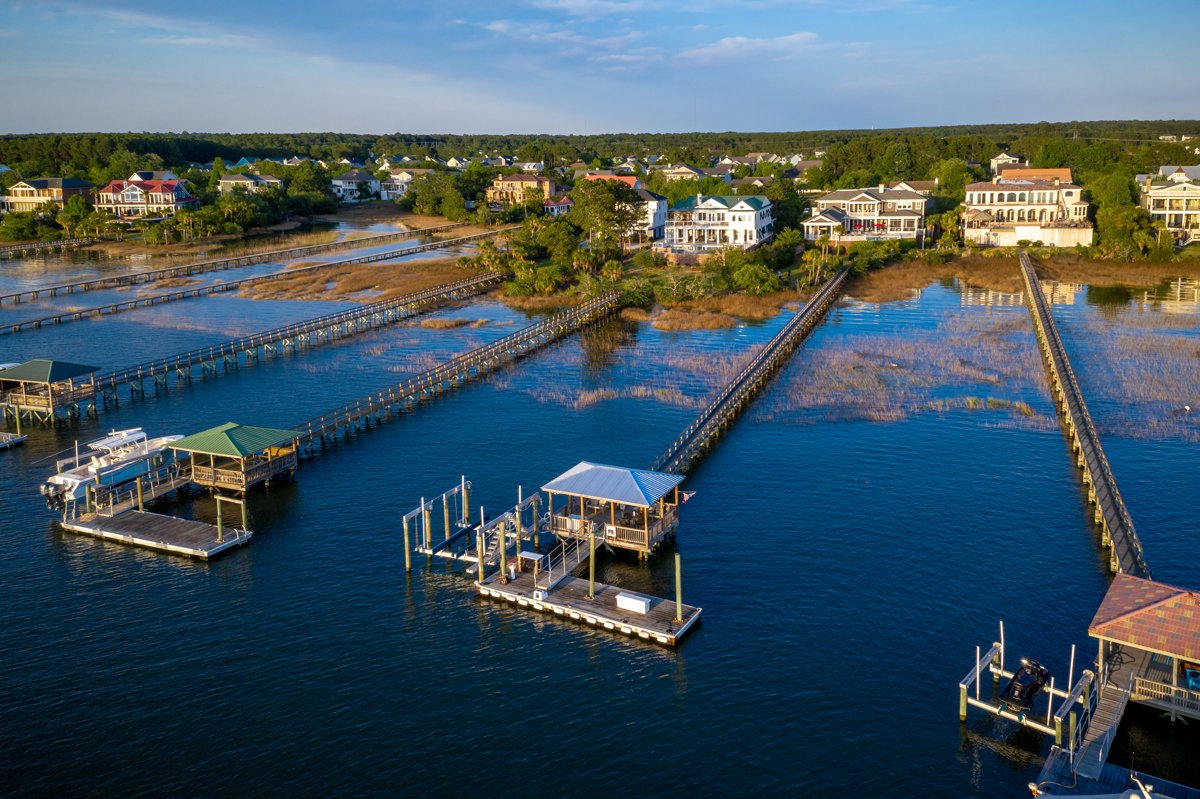
What Should You Check When Buying a Mount Pleasant Home With a Dock?
Buying a Mount Pleasant Home with a dock means verifying four things separately: that the dock is authorized by the South Carolina Department of Environmental Services (SCDES), that it's structurally sound, that your boat can reach usable water at low tide, and that you hold legal access and maintenance rights. A dock that physically exists is not the same as a dock that is permitted, usable, and yours to rebuild. Finish each of those checks before you're committed to the purchase.
Key Takeaways
- Single-family and other home types in Mount Pleasant sold at a median of $919,562 in July through September 2026, so a dock problem discovered late can erase a meaningful share of what you're paying for the waterfront.
- SCDES treats construction, repair, or alteration of a private pier or dock as a critical-area activity that requires authorization, even when it's classified as minor.
- SCDES's stated dock size limits depend on creek width: no docks on creeks 10 feet wide or less, and a 600 square foot maximum only on creeks wider than 150 feet.
- A department-certified Critical Area Line can be valid for up to five years, so check its certification date before you rely on it.
- Permitted, existing, and currently usable are three separate questions, and a dock can pass one and fail the others.
How Do You Verify a Mount Pleasant Dock Is Permitted?
Ask the seller for the complete dock file, then compare it against the physical dock and the state's records. The SCDES Bureau of Coastal Management reviews work in coastal waters and tidelands, and its critical area permitting program covers docks, piers, bulkheads, revetments, living shorelines, boat ramps, and dredging. Authorization is required before anyone alters a critical area.
What belongs in the dock file?
I walk my clients through requesting everything on this list before the offer becomes unconditional:
- The SCDES permit and any amendments or variances
- Approved drawings, the site plan, and permit conditions
- Inspection or completion records
- Correspondence about repairs, violations, or storm damage
If the seller doesn't have it, that's a finding, not a formality. Don't assume the paperwork exists somewhere just because the dock does.
Does the dock match what was approved?
Walk the dock with the plans in hand. Floating docks, pierheads, boat lifts, and boat-storage structures are specifically listed as additions under SCDES's minor activities framework. They look minor to a buyer, but they can require their own authorization. Check fixed sections, floating sections, walkways, pilings, lighting, and any lift against the permit description.
What is a Critical Area Line, and why does it matter?
The Critical Area Line is the boundary between upland property and the tidelands and coastal waters that SCDES regulates. Work seaward of that line may need a critical-area permit. SCDES explains how to request a Critical Area Line, and a certified line may be valid for up to five years. Get the certified line, confirm its date, and compare it with the existing dock, walkway, bulkhead, and any improvements you're planning.
Is the seawall or bulkhead permitted too?
Not automatically. Bulkheads, revetments, living shorelines, and other erosion-control work are regulated activities in their own right, as the SCDES permitting overview makes clear. A dock permit doesn't prove the adjacent shoreline protection, fill, or bank alteration is authorized.
Are there pending applications nearby?
Search SCDES records for the property and the neighboring shoreline. Dock proposals can go through public notice: a November 6, 2026 public notice in The Post and Courier covered a Wando River dock application in Mount Pleasant, with comments due November 16, 2026. A nearby dock, dredging project, or bulkhead can affect your views, navigation, and shoreline stability.
Will the Dock Work for Your Boat and Hold Up Over Time?
Only an on-site check at different tides and a qualified waterfront inspection will tell you. Listing photos taken at high tide hide mudflats, and a general home inspection usually isn't built to evaluate what's under the water. Buyers who treat these as separate questions avoid the most expensive surprises.
Is there usable water at low tide?
Visit at more than one tide. Note the creek or river frontage, where the navigation channel runs, approximate water depth at low tide, and whether the dock reaches usable water. A waterfront address and an existing dock don't guarantee a particular boat can reach or stay at the dock under ordinary conditions. Confirm clearance, turning space, and access to the water body you actually want to boat on.
Does creek width limit the dock?
Yes, it can. SCDES's frequently asked questions state these limits:
| Creek Width | Stated Dock Limit |
|---|---|
| 10 feet or less | No dock structures allowed |
| Under 20 feet | Generally does not qualify unless specified geographic circumstances exist |
| 20 to 50 feet | 120 square feet maximum dock area |
| 51 to 150 feet | 160 square feet maximum dock area |
| Wider than 150 feet | 600 square feet maximum dock area |
Those limits apply to what you could build or replace, and they're checked against your site's specific conditions during agency review. The size of the existing dock doesn't tell you what you'd be allowed to rebuild. If you're picturing a longer dock or a bigger platform, ask SCDES whether it's a minor or major activity before you rely on the marketing description. Larger or more complex projects such as community docks, dredging, and boat ramps fall under major activity review, and some developments are covered by a Dock Master Plan that can shape what any one lot is allowed to do.
What should a waterfront inspection cover?
Bring in a marine contractor, dock inspector, or structural engineer. They can evaluate submerged pilings, rot, marine borers, corrosion, loose hardware, electrical equipment, lift capacity, underwater scour, deck settlement, and the condition of bulkheads and revetments. Ask for an opinion on remaining useful life, not just a list of defects.
How do you check for erosion and storm damage?
Look for leaning pilings or seawalls, exposed roots, marsh edge loss, patched decking, and scour around supports. Compare today's shoreline with historic aerial imagery, and ask for records of hurricanes, flooding, emergency repairs, insurance claims, and prior engineering recommendations. This is lot-specific, and two neighboring properties can have very different histories.
Who Has the Legal Right to Use and Maintain the Dock and Access?
Confirm it in the documents, not in conversation. Ownership of the dock structure and the right to reach it are separate questions, and I see buyers assume the second just because the first looks obvious.
- Deed and plat: Confirm what the lot actually includes and where its boundaries meet the water.
- Easements and shared-drive agreements: Identify any rights to cross neighboring land or common areas to reach the dock.
- Covenants and dock-maintenance agreements: Learn whether the dock serves one lot or several, how repairs get approved, and how costs are shared.
Have your real estate attorney review these, since closings and title work in South Carolina run through an attorney. If a private landing, shared dock, or access road is involved, ask who is responsible for upkeep and what happens when owners disagree.
How Does the Mount Pleasant Market Affect Your Offer on a Dock Home?
Competition is real but not frantic, which gives you room to do dock due diligence. According to recent local market data, homes of all types sold in Mount Pleasant from July through September 2026 at a median of $919,562, up 2.2% from $900,000 in the same window a year earlier. Those homes sold at an average of 97.5% of list price, and 34% went under contract within two weeks of listing. About 33% of listings had a price cut, averaging 3.4%. Months of supply came in at 3.3, and homes for sale now number 591, with 181 new listings in the last 30 days.
Those figures cover all home types, not dock homes specifically. A waterfront home's price turns on water access, dock condition, the lot, and the house itself, so treat the median as context rather than a number for your target property. Here's how Mount Pleasant sits beside the other areas I serve:
| Area | Median Sale Price | Homes Sold |
|---|---|---|
| Mount Pleasant | $919,562 | 506 |
| Daniel Island | $1,587,055 | 102 |
| West Ashley | $512,356 | 250 |
| Isle of Palms | $1,619,229 | 48 |
Buying a Mount Pleasant Home with a dock on a shorter timeline is where mistakes happen. Fast-moving listings tempt buyers to skip the file review and the marine inspection. I'd rather help you structure an offer that keeps room for those checks than watch you take on an unpermitted dock or a mudflat at low tide. How inspection and due diligence timing works in your contract is something I'll walk through with you and your real estate attorney.
If you want the broader picture, my guides on waterfront homes with docks in Charleston and what to know before buying a waterfront home cover water access and ownership in more depth. Your Mount Pleasant homebuyer strategy should account for all of it before you write an offer.
Want to see what other clients have said about working with me? Read my reviews on Google, Zillow, and Realtor.com.
FAQ
Can I legally use the existing dock if the seller cannot find the original permit?
Don't assume you can. A dock being in place doesn't prove it was authorized, and SCDES requires authorization before anyone alters a critical area. Ask for any records the seller has, search SCDES records for the property, and have your real estate attorney advise you on the risk before you commit.
How do I verify whether a Mount Pleasant dock is permitted?
Request the permit, approved drawings, and permit conditions from the seller, then check them against SCDES records and the physical dock. Compare every fixed section, floating section, lift, and storage structure with the approved plans. Also get the certified Critical Area Line and confirm its date.
Does the creek's width limit the size of a dock?
Yes. SCDES states that no dock structures are allowed on creeks 10 feet wide or less. It states maximum dock areas of 120 square feet for creeks 20 to 50 feet wide, 160 square feet for 51 to 150 feet, and 600 square feet for creeks wider than 150 feet. Your site's conditions and current agency review still control the outcome.
Can I rebuild or enlarge the dock after closing?
Possibly, but it needs authorization and isn't guaranteed. Repair, alteration, and additions to a private dock go through SCDES's critical-area process. Contact SCDES before closing to ask whether your plan is a minor or major activity, whether a current certified Critical Area Line is needed, and whether a Dock Master Plan applies.
Who is responsible for maintaining a shared dock, access road, or private landing?
That's set by the documents, not by custom. Review the deed, plat, easements, shared-drive agreements, covenants, and any dock-maintenance agreement to see who approves repairs and how costs are divided. Have your real estate attorney confirm before you close.
The core takeaway when Buying a Mount Pleasant Home with a dock is to verify permit, condition, water access, and legal rights as four separate questions. I'll help you build that review into your offer and coordinate the right marine and legal professionals. Contact me to schedule an appointment, or download our buyers guide to start. You can also browse waterfront homes with docks in South Carolina.
Equal Housing Opportunity. Kimberly Ritter is a REALTOR® with Carolina One Real Estate, licensed in South Carolina, and a member of the South Carolina Association of Realtors. This article is general information, not legal, tax, or financial advice; confirm your own details with your real estate attorney, tax advisor, or lender.