
Relocating to Charleston for work, what should you compare first?
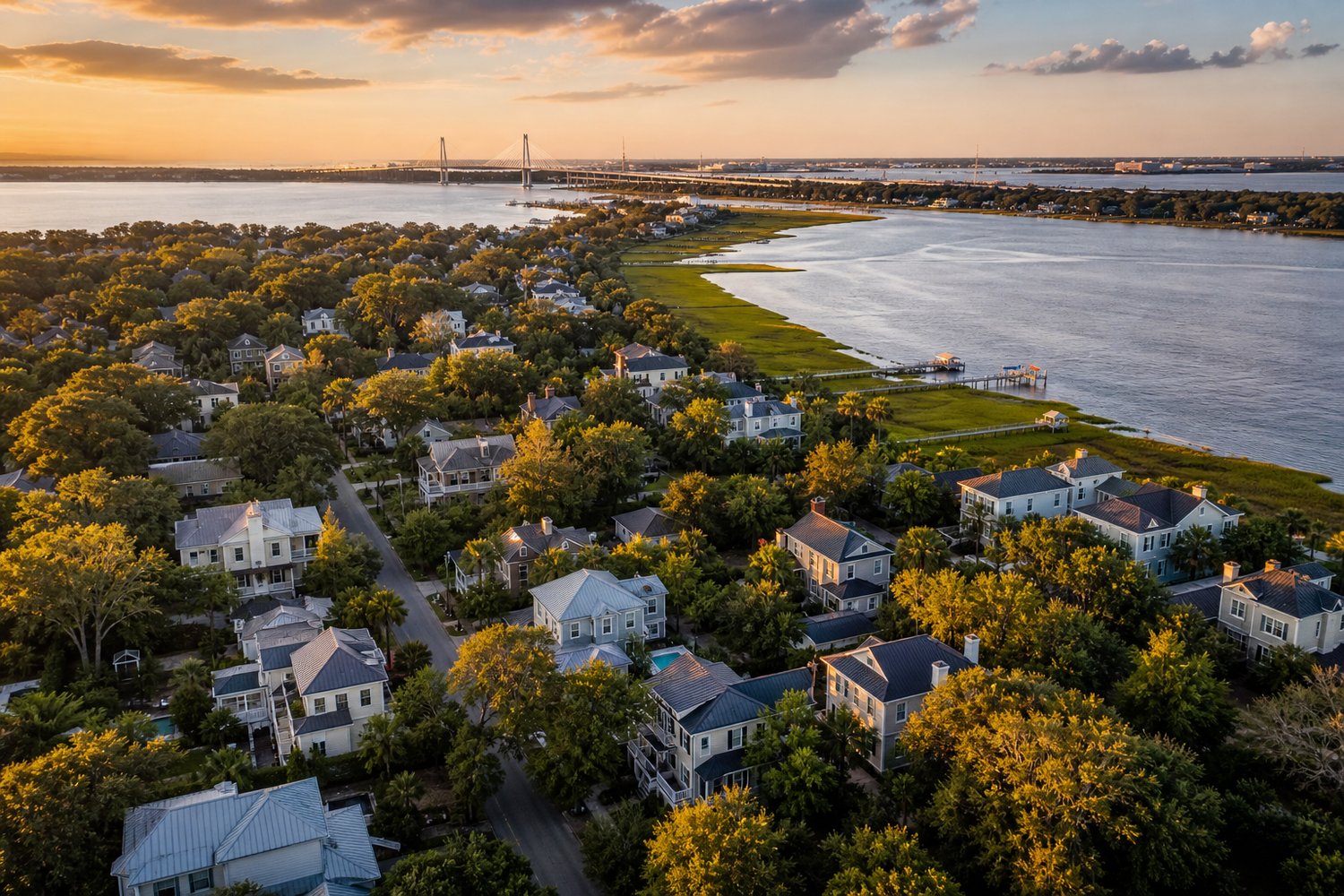
Compare three things in order: where your employer actually sits, how the route performs at your real start and end times, and what kind of home each area offers. Mount Pleasant gives you suburban housing with the Ravenel Bridge to the peninsula, Daniel Island gives you planned-community living tied to I-526, and Downtown Charleston gives you walkable daily access with a more urban home. Relocating to Charleston for work goes better when you map the job first and choose the neighborhood second.
Key Takeaways
- Daniel Island's median price was reported at $2,267,000 as of October 31, 2026, compared with $1,391,250 for Lower Mount Pleasant and $725,000 countywide.
- Mount Pleasant is not one search area: Lower Mount Pleasant favors direct Ravenel Bridge access, while Upper Mount Pleasant leans toward newer master-planned communities farther from Downtown.
- Among all home types sold in Mount Pleasant from August to October 2026, 35% went under contract within two weeks of listing and homes averaged 97.5% of list price.
- A short map distance does not mean a short commute, because the Ravenel Bridge, I-526, U.S. 17, and I-26 all behave differently at peak hours.
- A Daniel Island ferry to the peninsula was reported as a planned service, so don't count on it until the operator's schedule confirms it for your move date.
How do Mount Pleasant, Daniel Island, and Downtown Charleston compare for a work move?
They differ most in housing style, daily access, and how much space you get for the money. Downtown puts you closest to peninsula jobs, Daniel Island gives you a planned-community setting with regional road access, and Mount Pleasant offers the widest range of suburban homes.
| Area | Housing setting | Daily access | Main tradeoff |
|---|---|---|---|
| Mount Pleasant | Wide range, from homes near the bridge to newer master-planned communities | Ravenel Bridge (U.S. 17) to the peninsula, with Highway 17 running through town | Your experience depends on which part of town you choose and your employer's location |
| Daniel Island | Planned-community housing with neighborhood amenities and waterfront settings | I-526 and the Daniel Island bridge, with I-26 reachable through North Charleston | Short map distance does not guarantee a short drive |
| Downtown Charleston | More urban housing on the peninsula | Walking, biking, or transit to many peninsula destinations | Fewer chances to combine a large lot, a garage, and newer construction |
Why is a single “Mount Pleasant” number misleading?
Because the town contains different submarkets. The Post and Courier's reporting on Charleston County home prices treats Upper and Lower Mount Pleasant separately for exactly that reason.
Lower Mount Pleasant, which includes areas like Old Mount Pleasant, is generally the more direct choice if the Ravenel Bridge and peninsula access drive your decision. Upper Mount Pleasant puts more emphasis on newer master-planned communities, larger developments, and commercial areas farther from Downtown. I walk relocation clients through this split first, because it changes the search more than almost anything else.
How do the price levels compare?
Daniel Island sits well above Lower Mount Pleasant, and both sit well above the county as a whole. These are medians for defined market areas, not prices for a particular home or neighborhood.
| Market area | Median price |
|---|---|
| Charleston County | $725,000 |
| Lower Mount Pleasant | $1,391,250 |
| Daniel Island | $2,267,000 |
Daniel Island's median is roughly $875,000 higher than Lower Mount Pleasant's. That gap is real, but it reflects the mix of homes sold in each area, not a guaranteed price for the house you want. Downtown Charleston is not in that set, so I'd rather run current numbers for the exact property type you're considering than hand you a figure that doesn't fit.
Relocating to Charleston often changes your budget, too. In my experience, buyers raise their original range after touring homes. They see what the daily routine in each area actually costs and decide it's worth it. I tell them that early so it doesn't come as a surprise.
How fast is Mount Pleasant moving right now?
Recent local market data for all home types sold in Mount Pleasant from August to October 2026 shows a balanced, negotiable market. Months of supply was 3.8, and 35% of homes went under contract within two weeks of listing. Homes averaged 97.5% of list price, and 32% of listings had a price cut averaging 3.3%.
That means well-priced homes still move quickly, but you often have room to negotiate. Pace and pricing vary by street and condition, so your own search may look different from the town-wide picture.
How do you test a commute before you buy?
Drive the route your employer actually requires, at the hours you'll actually work. Don't rely on advertised drive times or an off-peak map estimate.
Which job location are you really commuting to?
“Downtown” is not one employment center. Before you pick a neighborhood, place your employer in one of these groups:
- The peninsula: professional services, hospitality, government, colleges, and cultural venues in a compact area.
- The medical district: a distinct destination from the rest of Downtown.
- North Charleston: industrial and aerospace employers.
- The airport corridor: its own pocket of employment.
- Suburban office concentrations: often reached more easily from Upper Mount Pleasant than from the peninsula.
A home that is convenient to Downtown can be a poor fit for North Charleston or airport-area jobs, even when both look close on a regional map.
What are the main routes, and what should you test?
The South Carolina Department of Transportation's existing conditions summary describes a regional system serving movement among Mount Pleasant, Daniel Island, Downtown Charleston, West Ashley, North Charleston, and other destinations. A few connections matter most:
- Mount Pleasant to Downtown: the Arthur Ravenel Jr. Bridge (U.S. 17) is the primary direct road link across the Cooper River.
- Daniel Island: I-526 and the Daniel Island bridge to Mount Pleasant, plus a peninsula-bound option through North Charleston to I-26, according to The Post and Courier.
- Downtown: for many peninsula destinations, proximity can be judged by walking, biking, or transit instead of mileage.
Relocating to Charleston conversations with me almost always include Highway 17 and North Mount Pleasant traffic, along with drive times to the beach and to the nearest marina. Put them on your test list too.
What does a good test drive look like?
- Drive from a candidate address to your employer at your real morning start time.
- Drive back at your real end-of-day time, since the return trip often behaves differently.
- Repeat on at least one other weekday.
- Test the backup route, because bridges and interchanges are where delays concentrate.
If you're also weighing the ferry, treat it carefully. A direct Daniel Island to peninsula passenger ferry was reported as a planned service. Confirm the operator's actual schedule for your move date before it becomes part of your plan.
If you want a deeper look at matching a home base to a specific job, I've covered that in choosing a Charleston home base for a tech job. For the logistics of the move itself, see Charleston SC relocation process tips for home buyers.
What does waterfront really mean in each area?
Waterfront is not one product. Harbor or river views, marsh-front homes, tidal-creek access, neighborhood docks, marina access, and direct deep-water frontage all differ in boating use, flood exposure, maintenance, insurance, and walkability.
Ask which of those you actually want before you compare areas. A marsh view and a deep-water dock can sit a few miles apart and live very differently.
Why do flood zones and insurance matter to the comparison?
Flood zones and elevation certificates affect insurance costs and what a waterfront home is truly worth. Wind and hail coverage can also differ east versus west of Highway 17. Get your insurance agent's input early, because it changes the real monthly cost of owning in one area versus another. I can point you toward the right questions, but your quotes will depend on the specific property.
On barrier-island properties, the Coastal Tidelands and Wetlands Act also matters for docks and building. If a dock is on your wish list, we'll check what is realistic for the lot before you fall for the house.
What about HOAs and amenities?
Planned communities, which are common on Daniel Island and in Upper Mount Pleasant, come with HOA realities: annual assessments, plus a one-time HOA capital contribution due at transfer. Ask for the details on any home you tour so the full cost of ownership is on the table.
Downtown trades community amenities for walkable access. You'll typically find fewer large lots, garages, and newer construction on the peninsula, so decide which of those you can give up. For more on that side of the comparison, see my Downtown Charleston real estate guide and my Mount Pleasant relocation guide.
You can read what past clients say about working with me on Google, Zillow, and Realtor.com.
FAQ
Is Mount Pleasant or Daniel Island better for commuting to Downtown Charleston?
Mount Pleasant, particularly Lower Mount Pleasant, is generally the more direct choice because the Ravenel Bridge (U.S. 17) is the primary road link to the peninsula. Daniel Island relies on I-526, the Daniel Island bridge, or a route through North Charleston to I-26. Test both at your actual commute hours before deciding.
How much more does it cost to live on Daniel Island than in Mount Pleasant?
Daniel Island's median price was reported at $2,267,000 as of October 31, 2026, versus $1,391,250 for Lower Mount Pleasant. That is a large gap, but these are medians for defined market areas, not prices for a specific home. The price of the house you want depends on its type, setting, and condition, so ask me to run the numbers for your target property.
Which Charleston-area neighborhoods let you walk to work?
Downtown Charleston is the strongest option, since employment, medical, higher-education, hospitality, and government destinations are concentrated in a compact area of the peninsula. Walkability still depends on exactly where your employer and your home sit. The medical district, for example, is a different destination from the rest of Downtown.
Is Downtown Charleston practical if I want a yard, garage, or newer construction?
It can be harder, because the peninsula is a more urban housing environment with fewer opportunities for a large lot, a garage, and newer construction together. Buyers who want that combination often look at Mount Pleasant or Daniel Island instead. It's worth deciding which features matter most before you start touring.
Does Daniel Island have a reliable ferry commute to Downtown Charleston?
Don't assume it does. A direct Daniel Island to peninsula passenger ferry was reported as a planned service, not an established option. Confirm the operator's current schedule for your move date before factoring it into your decision.
Where should relocation buyers go from here?
Relocating to Charleston for work works best when the job location comes first, the commute gets tested at real hours, and the home is matched to how you want to live. I personally handle every part of the process, from the first conversation to the closing table with your real estate attorney, so you have one person accountable for your move.
If you're ready to narrow the search, contact me to schedule an appointment and we'll map your employer, your routes, and your must-have home features together. You can also download our buyers guide to start preparing. If cost comparisons are on your mind, my post on the cost of living in Mt. Pleasant vs. Charleston is a good next read.
Equal Housing Opportunity. Kimberly Ritter, REALTOR® with Carolina One Real Estate, licensed in South Carolina; regulated by the South Carolina Association of Realtors. This article is general information, not legal, tax, or financial advice. Confirm your own numbers with your real estate attorney, tax advisor, or lender.